
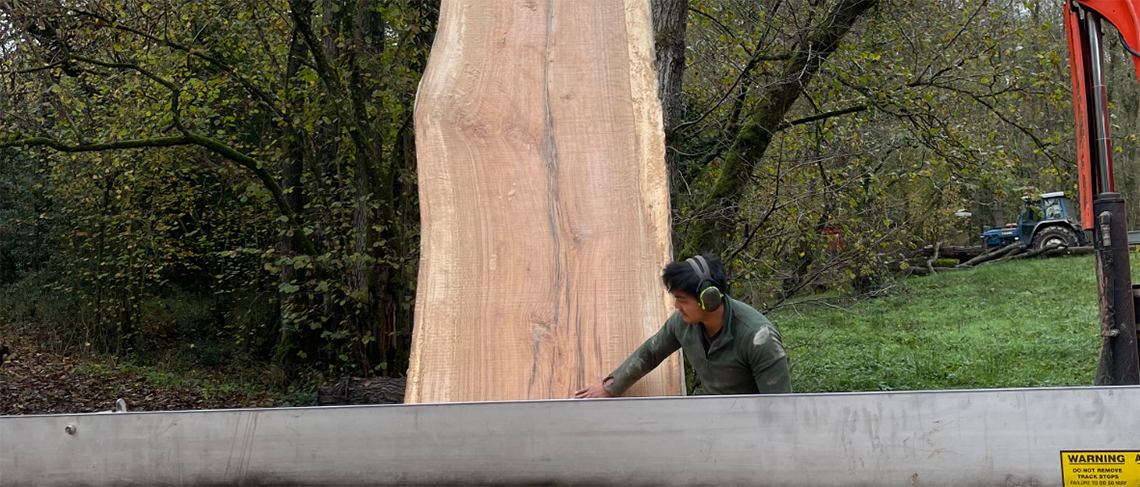
The Great Oak Table is a project account of converting one oak into components for a long community table. Jerry Andrada arranged the milling and supplied the timber. The finished length and the length of each sawn piece are different measurements.
Jerry reports that the oak was at risk of being cut for firewood. He arranged its milling and supplied the timber used in the table. The account describes sections approximately six metres long, assembled into a table approximately 18 metres long. This was timber from one tree, rather than one uninterrupted 18-metre slab.
However, we have not published measured drawings or a verified tree-age assessment. The reported 500-year age remains unverified here. Equally, we cannot establish a different exact age from appearance alone.
The Guardian report credits Elizabeth-Jane Baldry with the idea and Beej Trigg Woods with the table design. Jerry’s contribution was the timber milling and supply. These roles should be credited separately.
The Great Oak Table illustrates one route from an individual tree to a defined use. It does not establish that established sawmills reject all large or irregular logs. Instead, suitability depends on the particular mill, log, products and handling arrangements.
Before approaching a similar project, measure the logs and decide what pieces the design requires. Then assess access, handling, defects and equipment capacity. Also plan drying, storage and further preparation with the maker.
This account is not a measured comparison of profit, carbon emissions or timber recovery. Those claims would need costs, outputs and a credible comparison with alternative uses.
Useful additions include dated milling photographs, log measurements, a cutting record and confirmation of the assembled dimensions. A documented age assessment would also help clarify the age claim.
For another project, start with the intended use and the evidence available. Compare suitable processing routes before committing to equipment. The goal is to find a workable use for the timber, with the full costs and limitations understood.
For a similar timber project, assess the logs, intended use and processing route together:
Tell us about your logs, site and intended products. We can discuss machine suitability, demonstrations or a contract milling enquiry.