
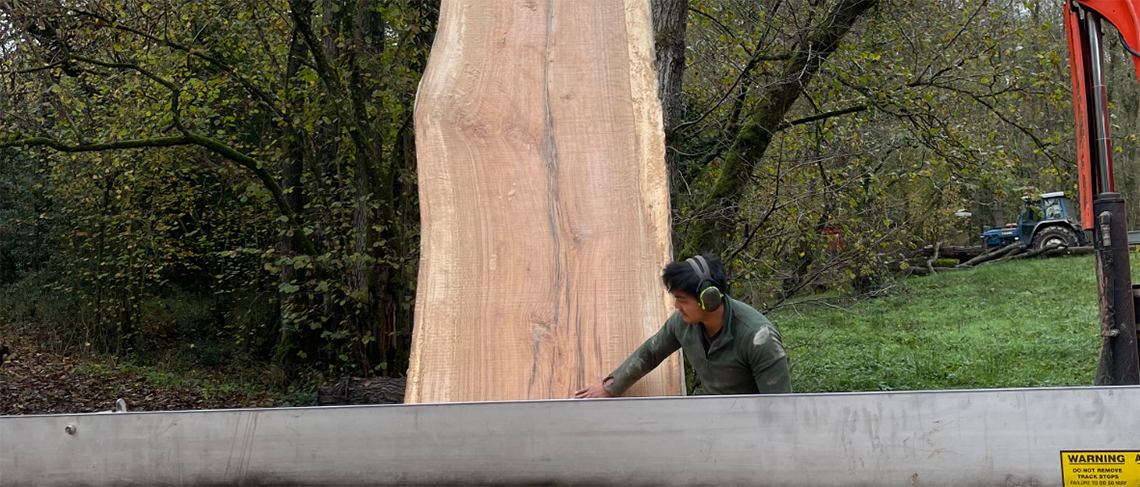
A national article recently described an 18-metre continuous oak table, reportedly cut from a 500-year-old oak tree. It made good copy: ancient oak, one single slab, monumental scale. But here is the story that was not told—and why the distinction matters for the future of UK forestry.
I was the one who prevented that oak from being cut into firewood, arranged its milling, and supplied the timber used in the table. Let’s correct the record:
The oak was at risk of being processed as firewood. Why? Because centralised sawmill systems are built for uniformity: standard log lengths, predictable diameters, high throughput, and commodity grading. Irregular, oversized, or character-heavy timber often does not fit that system. And when timber does not fit the system, it gets downgraded.
Using a Peterson mobile sawmill, we were able to mill the oak at scale, section it appropriately, preserve its structural integrity, retain its character, and convert it into long-format table components. This is what on-site large oak milling in the UK looks like when the goal is value, rather than simply volume.
Historically, oak like this would have built halls, framed barns, formed communal tables, and stayed within its region. Timber was processed near where it grew. Modern centralisation shifted that—not because it is inherently wrong, but because it optimises for efficiency, not irregular beauty. A single monumental oak does not suit an industrial line, but it perfectly suits a mobile system.
This case highlights a wider issue in UK forestry. Large character timber is undervalued, estates lack local processing options, central mills prioritise throughput, and communities lose narrative ownership of their trees. Without decentralised milling capacity, this oak would have been ash. Instead, it became an 18-metre table built from one tree. Not mythical. Not 500 years old. But real, and properly utilised.
This isn’t just about correcting a headline. If foresters, landowners, and small-scale producers do not control the supply chain—and the processing—they also do not control the narrative. Timber becomes a romantic myth or a lifestyle feature, instead of what it actually is: natural succession gifted to us by previous generations.
Our responsibility is not to romanticise it. Our responsibility is to manage it properly, process it locally, extract fair value, and pass on the same opportunity to the next generation. When timber is milled locally, the relationship stays intact. Communities understand where it came from, they see its conversion, and they participate in its value.
Mobile sawmilling is not about nostalgia. It is about ensuring forestry serves communities first—not headlines. Because if we don’t supply, process, and explain our own timber, someone else will explain it for us. And they won’t always get it right.
Mobile sawmilling provides a decentralised infrastructure that changes the outcome for unique timber:
Whether you’re looking to diversify your farm or start a milling business, we can help you find the right sawmill for the job.