
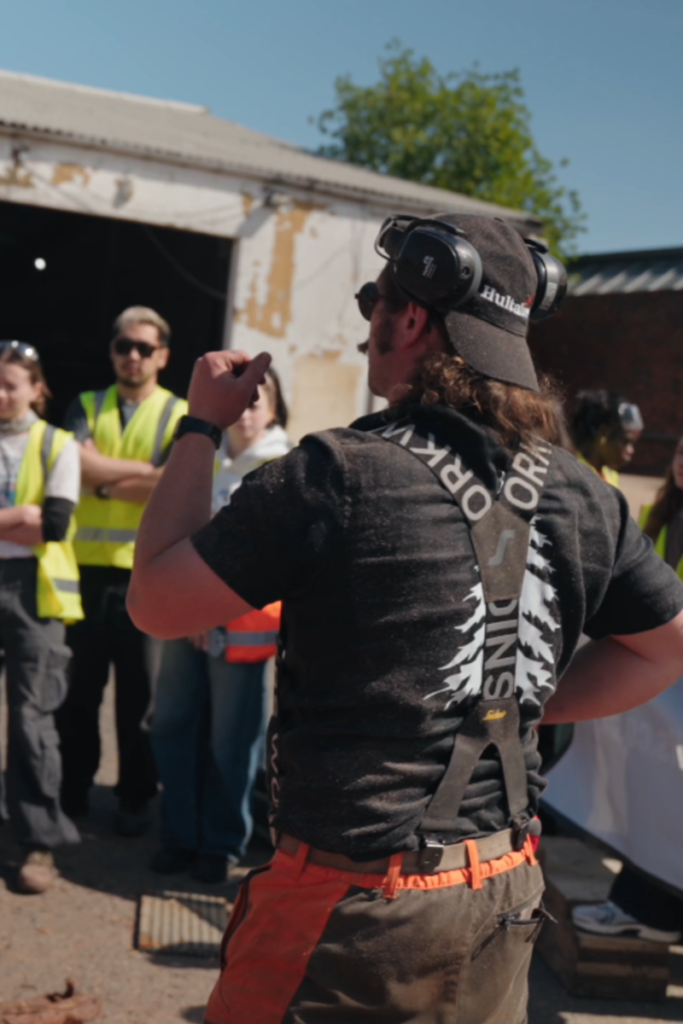
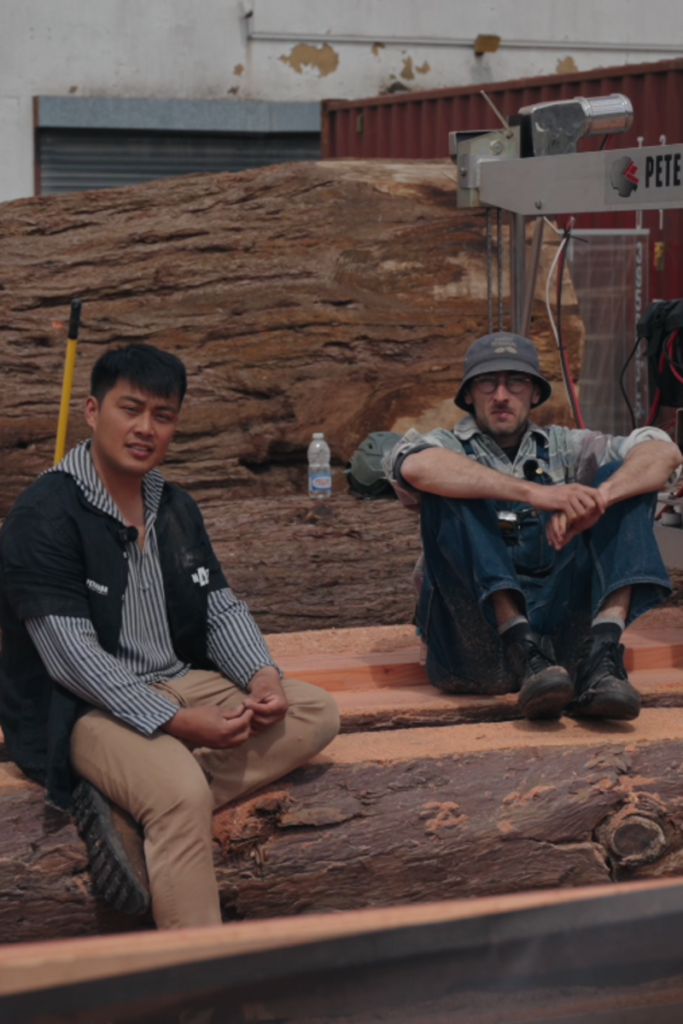
In May 2026, National Sawmills travelled to London to support a public timber conversion demonstration alongside YesMake, Resolve Collective, Tipping Point East, Central Saint Martins and Zetteler.
The demonstration was later featured in The Guardian.
At the centre of the event stood a Sequoia from Lynford Arboretum. The tree had died approximately five years earlier. Now, in the middle of London, people were able to watch it being converted into usable timber.
At first glance, that might not sound particularly remarkable. But throughout the demonstration we found ourselves answering the same question repeatedly.
The question caught us off guard. Not because it was unreasonable. Because it highlighted something much bigger.
Timber is one of the most widely used materials in society. Yet most people have never witnessed how it is produced.
Yet ask the average person how a standing tree becomes structural timber and the answer is often less clear.
That isn’t a criticism. It’s simply the consequence of distance.
What happens when an entire society becomes disconnected from the production of one of its most important materials?
Forestry is often presented through images of ancient woodland, wildlife habitats and beautiful finished products.
Those things matter. But they only represent a fraction of the story.
Between a standing tree and a finished building sits a chain of decisions, labour, machinery, infrastructure, logistics, investment and risk.
The public often sees the beginning and the end. Rarely the middle.
Yet it is the middle where most of the value is created.
Perhaps that is why some countries think about forestry very differently.
One of the most remarkable examples can be found in France.
Some of the country’s finest oak forests are managed on rotational cycles approaching 250 years. The oak selected for the restoration of Notre-Dame Cathedral was planted generations before the French Revolution.
In many cases, six or seven generations of foresters contribute towards a single crop before it is harvested.
Think about that for a moment. The people planting those trees knew they would never personally benefit from the timber. Yet they planted them anyway.
Forestry, at its best, is one of the longest conversations a society can have with its future.
The outcome is not simply timber. The outcome is understanding. Entire generations grow up recognising that forests are not static landscapes. They are managed landscapes.
When people lose sight of how materials are produced, they also lose the ability to participate meaningfully in the conversation surrounding them.
The result is often well-intentioned debate with very little understanding of how forestry actually functions.
This matters because forestry is not simply about trees.
It is about employment
It is about land management
It is about infrastructure
It is about manufacturing
And ultimately, it is about understanding where materials come from.
Without that understanding, communities become increasingly disconnected from the resources that surround them. People become familiar with woodland but unfamiliar with forestry. They recognise timber products but rarely see timber production. They understand the outcome but not the process.
France is not alone. Countries such as Finland and Austria offer similar lessons.
In Finland, hundreds of thousands of families own woodland. Forestry remains visible. Children grow up understanding that forests provide recreation, habitat, employment, materials and energy. The idea that a tree may eventually become timber is neither controversial nor surprising. It is understood.
Austria provides another example. Forestry remains closely connected to rural communities and local economies. Small and medium-sized woodland ownership is common. Sawmills remain visible parts of the landscape rather than hidden infrastructure at the edge of public awareness.
The result is not simply more timber production. It is greater public understanding. People know where timber comes from because they regularly encounter the process.
Britain often feels different. Many people can walk through woodland without ever seeing a sawmill. Many people use timber every day without understanding how it was converted. Many people hold strong opinions about forestry despite never having witnessed the process.
Again, that is not a criticism. It is simply the consequence of distance.
The purpose of bringing a Sequoia into London was never to produce timber. The timber itself was almost secondary.
The real objective was understanding.
For a brief period of time, students, architects, designers, community groups and members of the public could observe something that is normally hidden from view.
Most importantly, they could connect the finished products they use every day with the realities of how those products are produced. That connection matters. Because communities cannot make informed decisions about forestry if they never see forestry.
Britain currently imports a significant proportion of the timber it consumes. Yet Britain continues to grow timber.
The challenge is not simply about trees. It is about visibility. It is about understanding. It is about recognising the infrastructure, skills and knowledge that sit between a standing tree and a finished product.
The Sequoia demonstration was not intended to romanticise timber. It was intended to expose the process. To provide tangible evidence of how timber moves through society.
From tree. To conversion. To use.
Because if communities are expected to participate in conversations about forestry, they should first have the opportunity to see it. Only then can they decide what role forests should play in their future.
And perhaps that is the most important question of all.
Why do so few people ever see how it is made?
Experience mobile sawmilling and understand how local timber becomes structural material. Book a demonstration with our team.